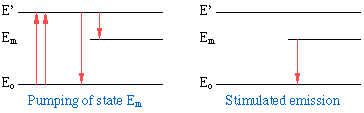
Suppose we have a system that consists of three levels. The lowest level is the ground state and has energy Eo. The highest energy level has energy E' and decays quickly to either the ground state or the intermediate state. The intermediate level has energy Em and does not decay quickly to the ground state. If we excite electrons into the highest state, some will decay to the ground state and some will decay to the intermediate state. After many excitations, a large fraction of the system will exist in the intermediate state.
If more atoms exist in the excited state, with energy Em, than in the ground state, then we have "population inversion".
If a photon of energy Em - Eo is then introduced, "stimulated emission" will take place. This effect was first described by Einstein, and it uses the fundamental property that photons prefer to be in the same energy state. Thus, if a photon with energy Em - Eo is present in the vicinity of an atom in the excited state with energy Em, then this atom will likely make the transition to its ground state and emit another photon with energy Em - Eo. Thus the number of photons with exactly this energy Em - Eo exponentially increases due to stimulated emission.
As a consequence, most of the electrons in the intermediate state will decay, producing an intense, monochromatic burst of light. This process is termed "light amplification by stimulated emission of radiation", laser.
© MultiMedia Physics 2000