The Bohr model described the hydrogen atom that has a single electron. However, in atoms of heavier elements, there are many electrons. These electrons interact with each other as well as the atomic nucleus. Thus the simple Bohr model has to be modified to account for these interactions.
[Remark on vocabulary: the lowest energy state is often referred to as "ground state". All other energy states have higher energy and are called "excited states].
For example, the lowest energy state in the Bohr model is n = 1. If a complicated atom with many electrons is in its ground state, one would then expect to find all the electrons in the n = 1 state. This expectation is contradicted by experiments.
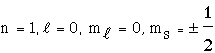
Pauli proposed a solution by postulating that no two electrons can occupy the same quantum state. The Pauli exclusion principle states that electrons in an atom cannot have the same four quantum numbers. Electrons will occupy the lowest states possible without violating the Pauli exclusion principle. The electron in the hydrogen atom ground state would have the following quantum numbers
The two electrons of the ground state of the helium atom would have the following quantum numbers
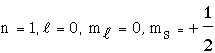
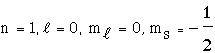
This Pauli Exclusion Principle also hold for excited states of atoms.
© MultiMedia Physics 2000