 One
of the most important developments in quantum physics was the
combination of Rutherford's model of the atom with quantum concepts.
The description and exploration of this quantum model of the atom
will keep us busy for the rest of this chapter.
One
of the most important developments in quantum physics was the
combination of Rutherford's model of the atom with quantum concepts.
The description and exploration of this quantum model of the atom
will keep us busy for the rest of this chapter.One
of the most important developments in quantum physics was the
combination of Rutherford's model of the atom with quantum concepts.
The description and exploration of this quantum model of the atom
will keep us busy for the rest of this chapter.
At the turn of the 20th century the existence of the electron was well established. However, the composition of atoms was not well understood.
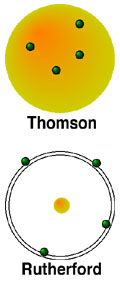
One model of the atom was put forward by Thomson. It was the "plum pudding" model in which it was postulated that electrons (plums) were interspersed in a positive medium (pudding) that exactly canceled the charge of the electrons (see top part of the figure on the right). At about the same time, Rutherford showed that the alpha particle scattering data of Geiger and Marsden, two junior members of his research team, could be explained by assuming that most of the mass of an atom was concentrated in the center, the so-called nucleus of the atom. Rutherford further postulated that the electrons orbited the positively charged nucleus like a miniature solar system. Both of these postulates turned out to be essentially correct.
The problem with this model was that classical electrodynamics predicted that the electrons would radiate and fall into the nucleus in 10-10 s. The Danish physicist Niels Bohr solved this problem by theorizing that the electrons must exist in quantized orbits, and that electrons could move from orbit to orbit in quantum leaps. Bohr's postulates successful explained most of the observed properties of atoms.
Before we go on, let us first get a feeling for the atomic length scales:
© MultiMedia Physics 2000