Black Body Radiation
 Objects
that absorb electromagnetic radiation well also emit radiation well.
An object that absorbs all the radiation incident on it is called a
black body. Such an object is also a perfect emitter of
radiation; that is, no body at the same temperature emits more
intensity per unit area.
Objects
that absorb electromagnetic radiation well also emit radiation well.
An object that absorbs all the radiation incident on it is called a
black body. Such an object is also a perfect emitter of
radiation; that is, no body at the same temperature emits more
intensity per unit area.
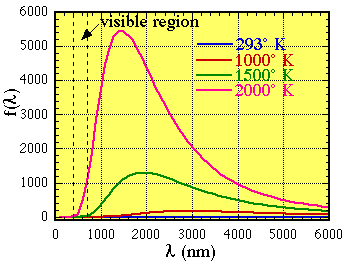
In the figure above, the distribution of electromagnetic radiation
emitted from a black body is shown as a function of wavelength for
four different temperatures. One can see that objects at room
temperature radiate in the infrared which is invisible to the eye but
are easily detectable. As any object gets hotter, it radiates more
strongly and its color changes. For example, as the element of an
electric range heats up, it begins to take on a dull
red color. As the temperature increases,
the element glows brighter. This doesn't happen on your stove, but if
the temperature would increase even more, the color would become
white, and then as the peak moves into the ultraviolet, the color
would turn blue.
The radiation emitted is not confined to a single wavelength but
exists over a broad spectrum of wavelengths. As the temperature of
the radiating body increases, the maximum of the distribution of
wavelengths shifts toward shorter wavelengths. To explain this
phenomenon in terms of classical physics, one approach is to assume
the emitting body is a cavity with a small hole that emits radiation.
One can then calculate the spectrum of radiation emitted in terms all
of the standing waves possible inside the cavity. At long
wavelengths, this method works. However, at short wavelengths, this
model predicts that the amount of radiation increases strongly as the
wavelength decreases. Experimentally one observes that the
probability of emitting electromagnetic radiation goes to zero as the
wavelength goes to zero. The divergence between the classical
prediction and the experiment is often called the "ultraviolet
catastrophe." It was a catastrophe for the classical physics of the
19th century.
As the temperature of the radiating body increases, the maximum of
the distribution of wavelengths shifts toward shorter wavelengths,
and intensity increases. The relation between the maximum of the
wavelength distribution and temperature is called Wien's displacement
law
$\lambda$maxT =
2.90·10-3 m·K.
It forms the basis of the optical pyrometer, a device which
measures high temperatures, for example in a furnace, by observing
their color. The intensity of radiation emitted from a black body is
proportional to T4, with T in K, naturally.
©
MultiMedia Physics
2000