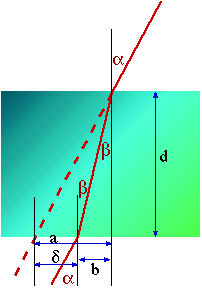
A light ray is incident (with angle
The angle
On the other side of the block, another refraction occurs, and the
outgoing ray again has the angle
In dealing with systems of lenses, one has the effect of refraction as well as this displacement effect. Usually, the diffraction effect dominates, however, and one neglects the displacement: This is the thin-lens approximation.
Note that the size of the displacement depends on the angle of incidence of the light. (This is the basis of a device called an optical micrometer, used for measuring very small displacements far away from the observer.)
© MultiMedia Physics 2000