Damped Harmonic Motion
In practically all realistic situations, objects that are in
simple harmonic motion will slowly come to rest due to the presence
of friction forces, for example air
friction in the case of a pendulum. Because of friction, the amplitude of an object undergoing simple harmonic motion will decrease with time. It leads beyond the scope of this course to give a full discussion of these effects, but let us just remark that the general form of the equation for an object in simple harmonic motion with damping is
x(t) = A sin($\omega$t+$\delta$)
exp(-$\lambda$t)
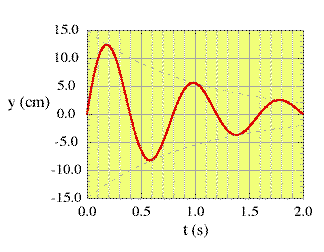 This
graph shows an example of harmonic motion with fairly strong damping.
As you can see, the amplitude of the motion is decreasing
exponentially with time. The blue dotted lines depict the exponential
while the red line shows the displacement. The parameters of the SHM
are the same as in the previous example, and
the exponential has the form ±15áexp(-1.0 $\cdot$ t). So the
equation of motion for the oscillation in this figure is given
by:
This
graph shows an example of harmonic motion with fairly strong damping.
As you can see, the amplitude of the motion is decreasing
exponentially with time. The blue dotted lines depict the exponential
while the red line shows the displacement. The parameters of the SHM
are the same as in the previous example, and
the exponential has the form ±15áexp(-1.0 $\cdot$ t). So the
equation of motion for the oscillation in this figure is given
by:
y(t) = 15 sin(7.85 s-1 t) exp(-1.0$\cdot$ t)
cm
If constant motion is desired when friction is present, a driving force must be added. Grandfather pendulum clocks, for example, only keep the pendulum swinging without visible signs of damping because a driving force is added by springs or weights. The energy for this driving force has to be added manually by "winding the clock up".
Damping of SHM may be desirable in some cases such as in the spring of a bathroom scale. An even better case for the need for damping can be made by looking at the shock absorbers in your car's suspension. The springs in your car will make the car bounce up and down when the shock absorbers are broken and thus not able to provide the damping.
© MultiMedia Physics,
1999/2000